
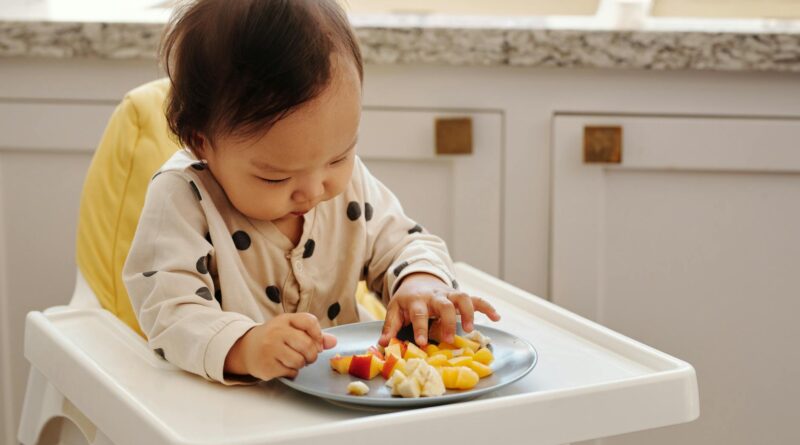
Webinar: Starting Solids in a Baby-Led Way
[Updated on November 5, 2025 to include video of the webinar LABBN hosted with Solid Starts for Registered Nurses and other staff of our network’s home visiting organizations and Welcome Baby hospitals. Scroll down or click here to view recording.]
Starting a baby on solid foods is an exciting milestone, but it also comes with important safety considerations. Parent Coaches in the Welcome Baby program support families through this stage, sharing guidance on developmental readiness, safe seating, choking prevention, and more.
In an LA Best Babies Network-hosted webinar on August 18, 2025 — for Parent Coaches and other staff of our network’s home visiting organizations and Welcome Baby hospitals — Kary Rappaport and Kim Grenawitzke from Solid Starts discuss:
- Signs of developmental readiness to start solid food
- Safe seating options for solid food and proper high-chair fit
- Strategies to serve finger foods safely to babies starting solids
- Differences between gagging and choking and how to respond
- Allergen introduction recommendations
- Foods to avoid when starting solids
- Free and low-cost resources available for providers and families
How do we know when babies are ready to start solid foods? Rather than focusing on a specific age, most major medical organizations now recommend looking for signs of developmental readiness. These signs indicate that a baby is ready to begin exploring solid foods and learning how to chew and eat. For most babies, this happens around six months of age.
Readiness for Starting Solids
- Ability to sit with support
- Ability to use the extremities flexibly in sitting while maintaining balance
- Interest in food and eating
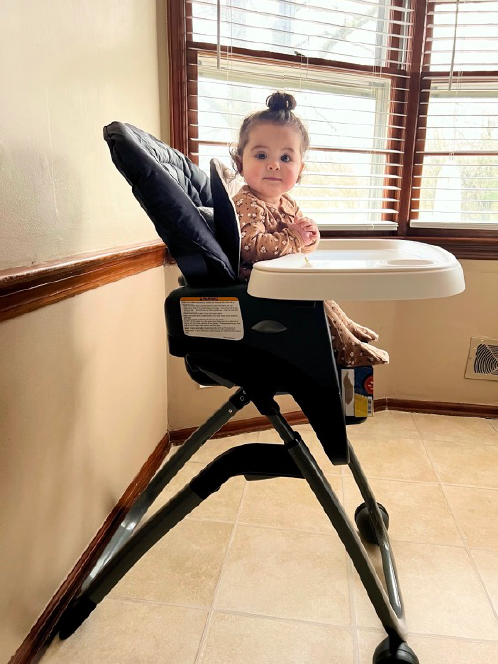
A proper seating setup helps keep baby safe during meals. Make sure your baby is positioned as upright as possible in their high-chair, with feet supported on a footplate. Ensure they can comfortably reach their food, and whenever possible, bring them up to the family table by removing the high-chair tray to promote inclusion and connection during mealtimes.
“Baby-led weaning” is a method where babies self-feed from the start, skipping traditional “baby foods” and exploring safe, family-friendly foods instead. Offering large pieces for grabbing or thick foods that stick to a spoon helps support self-feeding, while babies rely on their natural chewing and protective reflexes to stay safe, reducing the risk of choking.
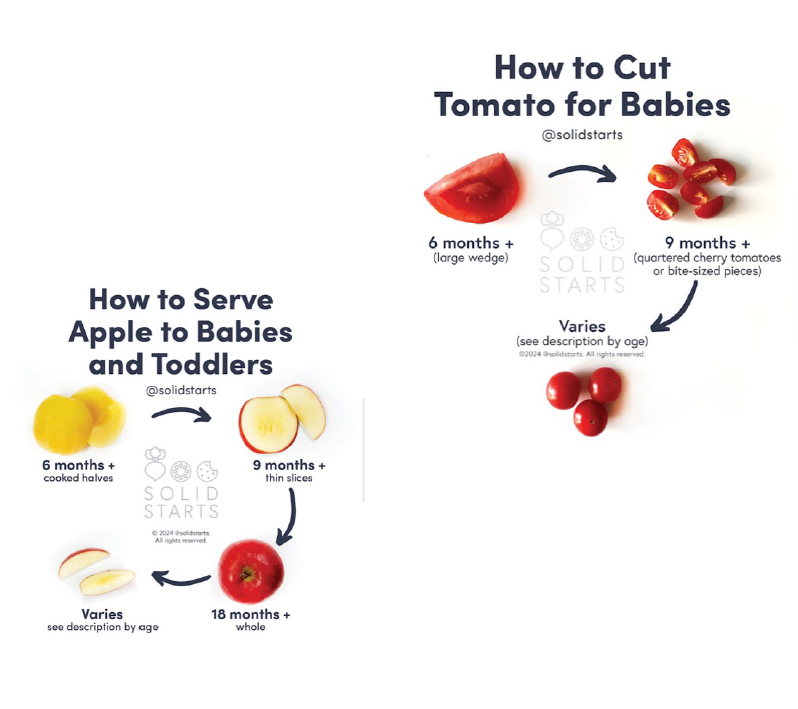
When offering solids, make sure foods are the right size and shape for baby to pick up easily. They should be soft enough to mash with the gums or firm enough to help develop chewing skills.
To reduce choking risk, always modify foods appropriately for baby’s age and abilities. Be especially cautious with foods that are small, round or tapered, firm or compressible, and slippery. These can increase the risk of choking and should be modified before serving to your baby.
In addition to avoiding foods that present a choking hazard, don’t offer foods that could make baby sick (e.g., undercooked meats or unpasteurized products) or foods that offer little nutritional value.
In the early months of starting solids, the focus is on learning. Breastmilk or formula will still be baby’s main source of nourishment. Begin by offering solids once a day, making sure baby isn’t too hungry when brought to the table. By around eight to nine months, aim for two solid meals a day, with a goal of reaching three meals a day by 11 to 12 months.
The American Academy of Allergy, Asthma & Immunology (AAAAI) recommends introducing common allergens, especially egg, peanut, and dairy, before a baby’s first birthday. For infants at high risk of allergies, emerging evidence supports beginning allergen introduction as early as four months of age.
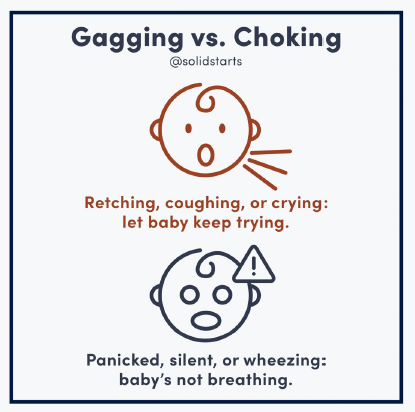
True choking is rare, even though it can seem more common due to media coverage. Gagging is a normal part of learning to eat and, while it may look uncomfortable, it’s not the same as choking. Remember: coughing is not choking, it’s actually a protective reflex that helps keep babies safe.
Watch the webinar and don’t miss the links to related resources below — including how to get a discount on the Solid Starts app:
About the presenters:
Kary Rappaport, OTR/L, MS, SCFES, IBCLC, is a senior feeding and swallowing specialist and the Executive Director at Solid Starts PRO. A mom of two, Kary specializes in family mealtime dynamics and eating issues across the spectrum—from breast and bottle feeding challenges and picky eating to dysphagia, tube feeding, and complex food refusal. She is a pediatric occupational therapist and international board-certified lactation consultant with over 20 years of clinical experience evaluating and treating pediatric feeding and swallowing disorders. Kary has worked in diverse settings, including pediatric outpatient clinics, inpatient hospitals, in-home private practice, and rural primary care at a Federally Qualified Health Center (FQHC). In addition to her clinical work, Kary co-created and launched a successful continuing education business in 2017 with Kimberly Grenawitzke, offering in-person and online courses on breastfeeding, oral motor skills, swallowing, and selective eating. Currently, Kary works for Solid Starts as a founding member of the team, where she has helped develop clinical recommendations and content for both Solid Starts and Solid Starts PRO.
Kimberly Grenawitzke, OTD, OTR/L, SCFES, IBCLC, CNT, is the Managing Director of Content & Editorial and a Senior Feeding & Swallowing Specialist at Solid Starts. She is a licensed pediatric occupational therapist with specialty certification in feeding, eating, and swallowing; an International Board-Certified Lactation Consultant; and a Certified Neonatal Therapist based in Michigan. Kim supports families by evaluating and treating feeding and swallowing challenges in infants and young children, including those with extreme prematurity, cancer and blood disorders, congenital heart disease, and other complex health conditions. With over 15 years of experience, she has worked in both home settings and leading medical institutions such as Children’s Hospital Los Angeles and Lucile Packard Children’s Hospital Stanford. Kim earned her Doctorate of Occupational Therapy from the University of Southern California. As a mom of two young children, she is a passionate advocate for research and education that bridge the gap between pediatric healthcare and families’ journeys with infant feeding—from birth through solid foods to family meals.
Together, Kary and Kim have co-created professional courses on pediatric feeding used in clinical training programs at Stanford University, the University of Southern California, California Children’s Services, and numerous pediatric therapy clinics across the U.S. Their courses form the foundation of Solid Starts PRO and support the pediatric feeding community worldwide.
Related Resources:
- Presentation slides for this webinar
- Solid Starts Website
- Solid Starts App
- Solid Starts Instagram
- First Foods Database
Earn 25% off and a 7-day free trial the first year of an annual membership to the Solid Starts App
Discount Code: LABBN25
Direct Link: www.solidstarts.com/app/?coupon=LABBN25
Terms:Use code LABBN to receive 25% off the first year of an annual app subscription to the Solid Starts app when you start your membership at solidstarts.com/app. This code is redeemable via our website only and cannot be used in the Apple or Google app stores.* To redeem the offer, sign in or create an account at solidstarts.com/app, select the Yearly plan, and apply the promotional code at checkout. Subscription is activated upon purchase. Offer is valid for first-time customers only. Does not apply to gift cards. Cannot be combined with other offers or applied to previous purchases. Subscription auto-renews at the regular annual price after the first year unless canceled before the renewal date. You can cancel or change your plan anytime by signing into your account on our website.